BABEL - Utstilling
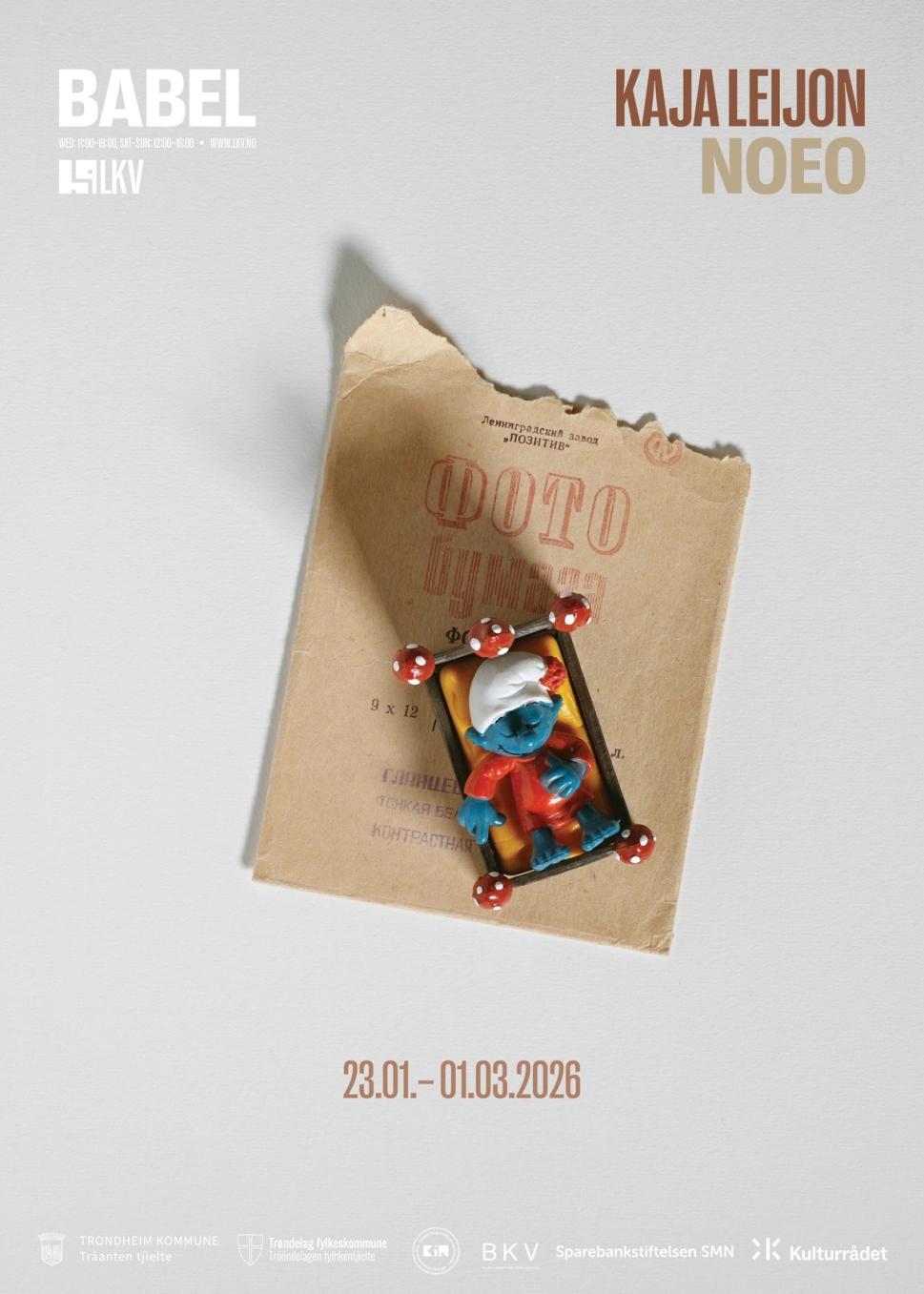
NOEO
Kunstner
Kaja Leijon
Åpning
Varighet
- Ons, 11–18
- Lør–Søn, 12–16
Arrangement

Nothing with mass can travel at the speed of light; everything without mass is forced to.
The other night I suddenly noticed my own blinking, realizing I hadn't been aware of my view going dark for brief moments, over and over, for a very long time. Then I became so aware that the only thing I noticed was the darkness between moments of sight. The intervals I had been unaware of for so long. I became conscious of how my eyes function as shutters, recording light not as a static stream, but in pulses, and how the blinking never echoed but rhymed with the beats of my heart. I noticed the darkness had a weight my perception didn't have, revealing how I color my field of view with the temperament of my vision.
We dream our lives, constantly shaping our experiences with projections of worth and value, to stay intact, to remain motivated as caretakers of the lives and objects that define our presence in the world, in time. As we take care, we cease dreaming. Caregiving becomes an unconscious ritual, confirming our inner longing for appreciation. We wipe the dust from the cherished item we left on that shelf for so long, for no reason at all, now looking back at us. So determined in its presence that to discard it would be a form of abuse. It reminds us of who we are, related to neither society nor self, but to the inner hum we nurture to keep a sense of composure intact. Equilibrium is manifested through rejuvenation. When these items are delicate, their materiality fragile, when they suffer from the degradation we too must experience through a lifetime, they become mirrors. Without them we are adrift; when they break or deteriorate, their original worth finally comes to light. This reminds us of the true condition of everything, including ourselves.
I must become inert, merge back, return to vastness, rejoin the infinite, and embrace endlessness. For billions of years we were scattered across space and time, only to coalesce into a perception that defines us; a mere blink of an eye. The stardust that made us drifts onto the surfaces of objects, gently reshaping the things through which we come to know ourselves. Those objects glow with meaning, lit by the quiet, personal light we carry into the intimate spaces we call home.
The light that falls across the garden illuminates the leaves, curving around each one and tinting their edges with tangerine, carried onward by the wind, and is as much an object as the porcelain owl that stares at me from the shelf each day, as the plastic toy abandoned on the carpet beneath the table, and as my sore back that prevents me from picking it up before nightfall. The relic I discovered, moving my body to another, unpredictably diverse corner of the planet, was adopted and now sits in a domestic space, trying to retain the significance it once held. Items become jealous of other items; artefacts are nullified by trinkets, turning the shelf into an epic class struggle, a clash of attraction between relics.
Objects are things we keep in our minds, and their value is defined by how we treat them, by the care we give them. Their worth isn’t rooted in physical presence but in the inverted shadows they cast when we blink. Our minds can grant them true value only through emotion, a value that money can never truly overturn, unless we choose to live a lie. We don’t define these possessions; they define us, and in doing so they become alive. They possess us. Our minds are museums of our own memories. How much time does it take to truly appreciate, wholeheartedly and without doubt, not the totality of it all but the elements that create it? A lifetime. They say we can’t see the forest for the trees, yet it is precisely the trees we overlook. The uniqueness of each singular stem; the way light slides down its bark, the moss climbing upward, the wind teasing every branch, the roots spreading unseen beneath our feet.
The space between things is also a thing, the most omnipresent item of all. Absence is the thing beyond things. We thread phantasmic light, pearl by pearl. Every image we capture and item we gather becomes a bridge between what is seen and what has already slipped away. Juxtaposition gives the gaps between elements relevance through reverence. Recording what the eye perceives is idealistic because it does not primarily create an object; it captures an idea of time, light, and presence. An image exists both as a projection of reality and as a physical expression, always pointing forward toward something that is disappearing or already gone. In weaving light through the void, we perform an idealistic act that nonetheless springs from the material world. Matter is not merely matter; meaning emerges through how items radiate verve, revealing life in what is and what is not.
In the realm of the tactile arts, the material itself is the starting point; meaning and form emerge directly from the substance being shaped. When making images with the eye, the result records an imprint of the world as it appears to consciousness, tying the medium more closely to imagination than to mere matter. I see the world as this and thus I project the world to thee.
If you can’t find beauty in light, then what beauty can you find?
The eye is naked, clothed by the faculties through which we filter our worldview. We weave the world’s hum into that fabric, negotiating constantly between the ambient altruism of the collective and the idiosyncratic singularity of the self. The hum itself is an object; a kind of cultural dark matter that shapes every thing, whether driven by desire or by pure physicality. Every object carries a trace of desire, non material or not. In a world where the metaphysical is endlessly instrumented for commerce, language has taken on a neoliberal sheen and desire has become a commodity. Creating art, then, is an act of resistance: we free ourselves from external pressures, unrestrained from outer influence; choosing enduring ideals before fleeting ideas.
We’re in desperation, clinging to the value of the elements that summarize our inner worlds and mirror ourselves through desire. We do this in resonance with our memories, pure perception, and through things of inherent value. These projections often degrade into sentimentality, though it is a natural, automated process. When we fail to embrace the value of our treasures, we lose the ability to sense life’s worth, and consequently we treat the world accordingly.
The candle is blown out from my lips as I blink. The day is remembered through shadowy flashes of light in my mind. On my desk lies a blank page and a fountain pen; drop by drop, it leaves specks of pigment on the sheet, the pigment losing a dimension as it melts into the paper and gaining countless dimensions through the dwindling sundown. Rays set the desk alight, saturating it with an amber hue as dawn approaches; they blend with sapphire, still lingering in the shadows of night. The droplets have turned into a stream that flows, creating a thick, black line that seeps into the paper and the oak surface, leaving stains that never heal, as I sleep until noon, my eyelids rapidly moving, hunting for light.
I drink air, I breathe water and I touch sound. The air carries me, the liquid flows through me and sounds caress me, as I stare in awe. I wait, for a moment, still. Breathing, I merge with the hum.
We enter the world; the world enters us.

Utstillingen er støttet av Kulturrådet, Billedkunstnernes Vederlagsfond og Regionale Prosjektmidler.