BABEL - Utstillinger
Once There Was a Way
Kunstner
Sjur Eide Aas
Åpning
Varighet
- Ons, 11-18
- Lør–Søn, 12–16

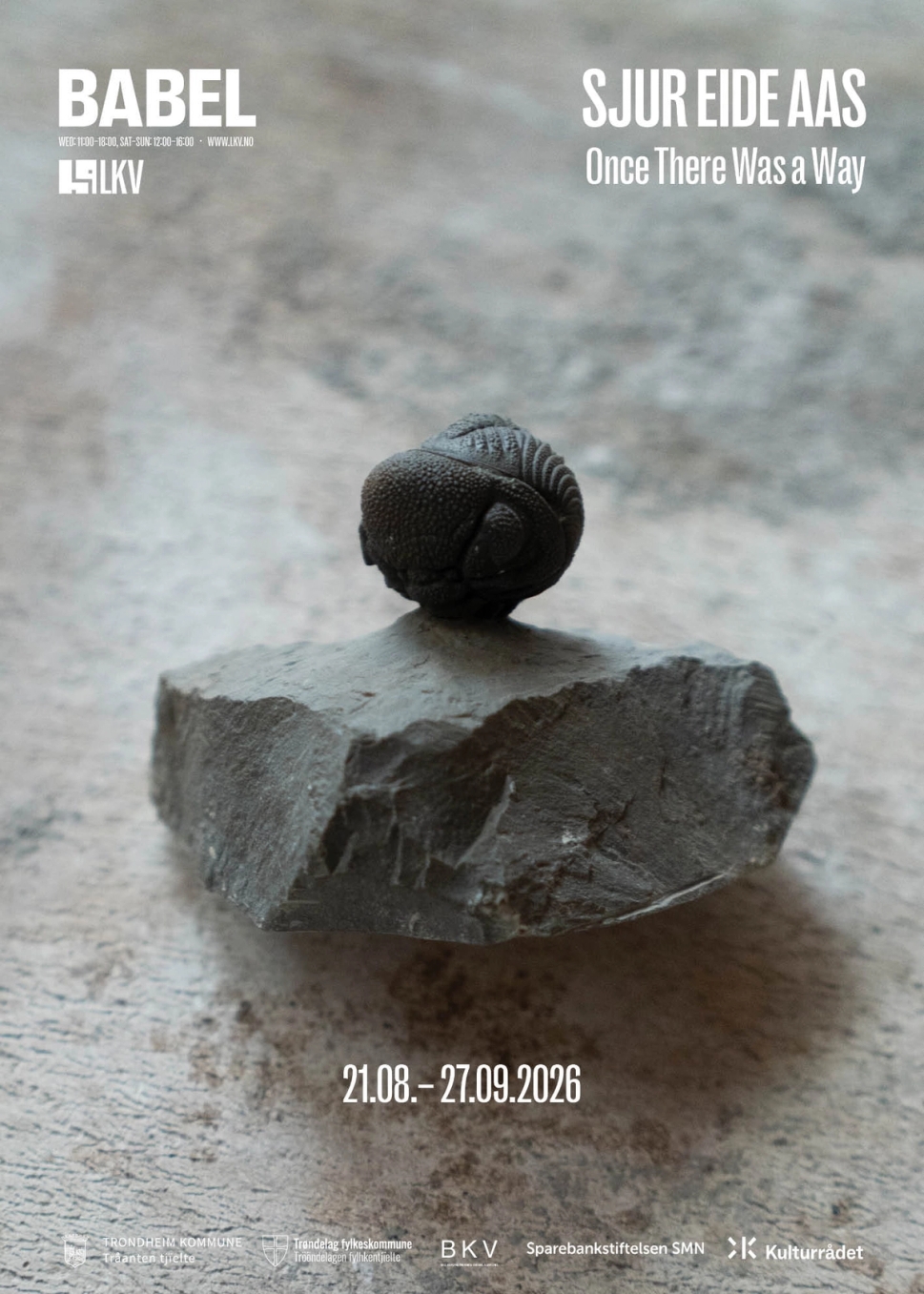
BABEL presenterer Once There Was a Way, en soloutstilling av Sjur Eide Aas.
Vernissage: 21. august 2026 kl. 18:00.
---
"Woven into its simplest and most basic laws is a power to the unpredictable. It's about how inanimate matter with no purpose or design can spontaneously create exquisite beauty. It's about how the same laws that make the universe chaotic and unpredictable can turn simple dust into human beings. It's about the discovery that there is a strange and unexpected relationship between order and chaos"
- "The Secret Life of Chaos” Documentary with Jim Al-Khalili.
All around us, there are these invisible, unyielding rules that dictate the outcome of everything. Take gravity, for instance. That constant phenomenon where objects tend to fall, sink, or move inexorably toward the center of a mass. On planet Earth, it is an all-defining law. It dictates every form of movement and shapes the very existence of the trilobite you see here on display in the exhibition.
Morocops ovatus: This distinct trilobite was found in the Jbel Issoumoure region in Morocco. Approximately 394 to 381 million years old, it lived as a seafloor-dwelling marine organism during the Devonian period. Like most phacopid trilobites, it was adapted to a low-level lifestyle, scuttling across the ancient seabed. It may also have acted as a fast-moving, opportunistic scavenger or low-level predator, feeding on small, soft-bodied organisms writhing in the primordial mud. And as chance may have it, here this specimen is fossilized precisely while in its defensive mechanism - all curled up, desperately protecting itself from something unseen. It is believed that rapid sedimentation, meaning sudden underwater storms, seismic shifts, or collapsing coastal shelves, triggered massive underwater avalanches of silt and mud. Burying it alive and preserving it in perfect condition.
In this exhibition, Once There Was a Way by Sjur Eide Aas, our gaze immediately focuses on several steel structures within the space, each emphasizing its own set of associations. Throughout the exhibition space, there are scattered flowers, plants, insects, mushrooms, fossils, and so forth. All these previously living organisms were found: some dried out like brittle flowers, others carefully selected like the trilobite fossil. Here it is, presented mysteriously levitating in mid-air. On the walls, a series of resin casts encapsulates various insects and flowers, seashells, bones, and a meteorite. Freezing them in a synthetic amber eternity. On the far end wall, we see a surveillance camera attached to an assembly of mirrors, reflecting the exhibition space back at itself. We see a rusted old bike locked to a pole, a metal circle on the floor. All these fragments are scattered around the room as if this were a puzzle or a cryptic game meant for us to solve.
Walking through it all, the exhibition feels as though we are part of a geological deep-drilling through the very history of the world. It deals in random natural events spanning centuries and thousands of years, stretching back into an era long before humans ever walked the earth. Here, there is no real distinction between time and space, human history or the cosmic bigger picture of things.
Turning around in the exhibition space, a canopy and a door emerge, and you realize that you are standing in front of a building’s façade. This all might seem banal at first glance. Everyday objects colliding with natural sedimentation processes - fossils meeting urban relics. Everything inscribes itself into the physical space and forms different traces, some more visible, others fading into obscurity. The physical and sensory reality of a place merges seamlessly with the memories andtraces of that same place, creating a quite surreal, dreamlike topography. Finally, when you realize that the last welded steel structure unmistakably resembles a UFO, it appears to be under construction or undergoing repairs.
In this work, we question our own human perceptual patterns. Sjur Eide Aas integrates experiential potentials into architectural structures across various spatial and urban conditions. In doing so, he expands a standard disciplinary understanding of our surroundings to include the sensual and geological nature of urban space, alongside the cosmic one, encompassing both the time before and the time after the brief epoch of humans. Reminding us that we are simply footsteps in the sand of time.